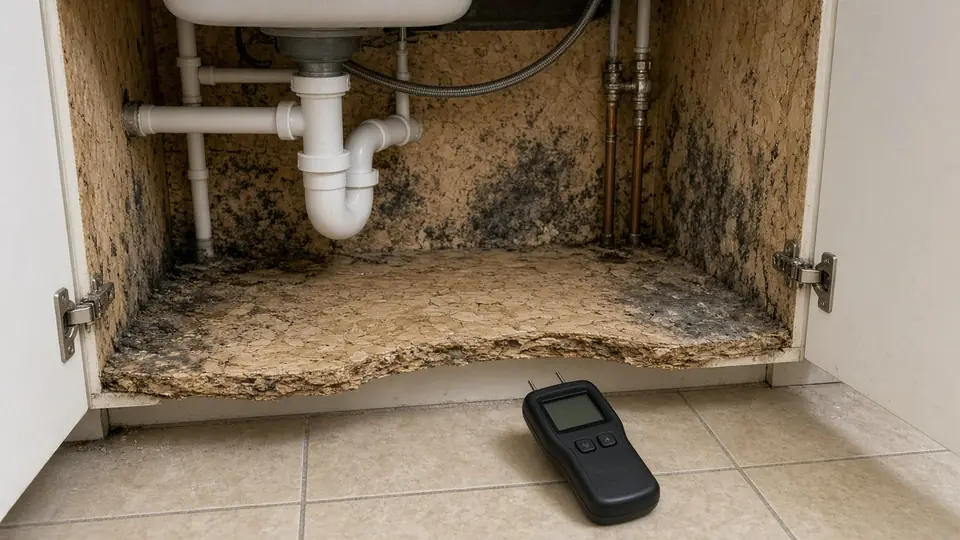
You are about to list a house whose basement has taken water
A listing date is close and the lower level has been wet before. You want to know what the paperwork asks and what to learn first. This guide lays out the state form and the Scarsdale sewer certificate as facts, then tells you what to ask so you are not guessing.
Ask what keeps the water coming back. Asking commits you to nothing.
We help you find out what keeps sending water downstairs and get an assessment booked first, with any removal or drying from a different company after it.
In writing, before you book
Asking us costs nothing and binds you to nothing.
We ask what brings the water back before anyone cuts.
Whoever checks the result is not who removed the mold.
The $100 is applied the way our Terms page sets it out.
Each contractor answers for the work under their own contract.
What the disclosure form and the sewer certificate ask.
Start with what you actually know
Before you read a form, make a short list. When did water come in? Which rain was it? Did anything come up a drain? What was repaired, and by whom? Keep every report and receipt in one folder.
A sale tends to raise all of these questions at once. Settling them in your own mind first makes every later conversation easier. If you cannot answer one, that is the item to find out now.
What the state form asks
A residential seller completes New York's property condition disclosure statement and gives it to the buyer or the buyer's agent before the buyer signs a binding contract. Flood questions were added to the form on March 20, 2024.
The form asks about standing water from drainage or grading trouble, seepage, and damage from heavy rain. It asks whether you ever made a flood claim. It also asks whether anyone tested the home for indoor mold, and wants a copy of the report if so.
Read each question against your list. Where you do not know the answer, find out the history before you fill the form in, rather than guessing.
The Scarsdale sewer certificate
In the Village of Scarsdale, Local Law 5 of 2023, now Chapter 244 of the Village Code, calls for a Discharge Compliance Certificate when a property is sold. It is also needed before residential building permits above $100,000. Enforcement began on October 1, 2023.
A Westchester County plumber, or a New York engineer or architect, does the inspection. They film the entire sewer lateral and report any sump pumps. After a satisfactory inspection, the Village Building Department issues the certificate, and the Village sets its validity at five years.
We do not supply, arrange or certify that certificate, and a mold job does not replace it. If you need it, ask the Building Department how to begin, and ask the professional you hire what they will film.
The Village's list of defects names four connections into the sanitary sewer: a sump pump, a driveway drain, a yard drain and a roof leader. Each has to be cut off and rerouted onto the property or into a drywell. Where your basement took water in a regular rain, a connection like that could be one reason.
That is worth learning early. A connection found at sale can mean work before closing. One found now leaves you time to plan it. Ask whoever films the lateral to tell you what they see, and ask the assessor whether it fits what happened in your basement.
What mold work does and does not do for a sale
A mold assessment tells you what is affected and what caused it. A removal takes out what the assessment found. Neither one answers the disclosure form for you. The form asks about facts of your property, and the answers are yours.
What the work gives you is a clearer history. You can say what was found, what came out and what was fixed. Ask each contractor for a written record that names the cause and the date it was closed, not only the date the mold came out.
If you are the buyer
Buying a house with a wet lower level? Read the seller's form against the same list. Ask what water came in, when, and what was done about the cause. If the house is in Scarsdale, ask whether the sewer lateral has been filmed.
A fair question for anyone is where the water enters and where it goes next time. If nobody can say, an assessment before closing may be worth the time. Tell us your timing and we will help you book it.
If the basement was repaired years ago
An old repair is not the same as a closed cause. A wall that was dried and repainted may say nothing about why it got wet. Ask yourself what was done at the time. Was the water path found, or only the damage? Do you have the paper?
If the answer is only the damage, an assessment now can show whether anything is still active. It can also show that nothing is, which is a useful finding. Either way, you will know the history instead of assuming it.
Timing the work around a closing
Work takes time to book and finish, and some steps must come in order. The assessment comes first, removal follows, and a check afterward comes last. If a closing date is fixed, count back from it and leave room for each step. Tell us your dates, and we will help you start with the assessment while there is still room.
What we do and do not do here
We are not your agent, your attorney or the inspector of record. We do not answer the form for you, and we do not tell you what to disclose. We help you find the cause and book the first step, and we tell you what to ask. The decisions stay with you and the professionals you hire.
Questions to ask now
Which rains wet the lower level, and when?
Did any water rise from a floor drain or toilet?
Has the sewer lateral been filmed, and what was reported?
What was removed, what was cleaned and who checked the result?
Who fixed the path, and is that written down?
Take that list to your agent, your attorney and your contractor. Each of them can help with the part that is theirs. Ask your agent when the form must reach the buyer, and plan so the assessment findings are in hand by then.
Keep the paper in one place
Whatever you decide, keep a folder with the assessor's findings, the scope, the contracts, the receipts and the dated photos. If a buyer, an agent or an attorney asks about the lower level later, you can hand over facts instead of memories.
If you have nothing yet, start today with a phone album and a notes file.