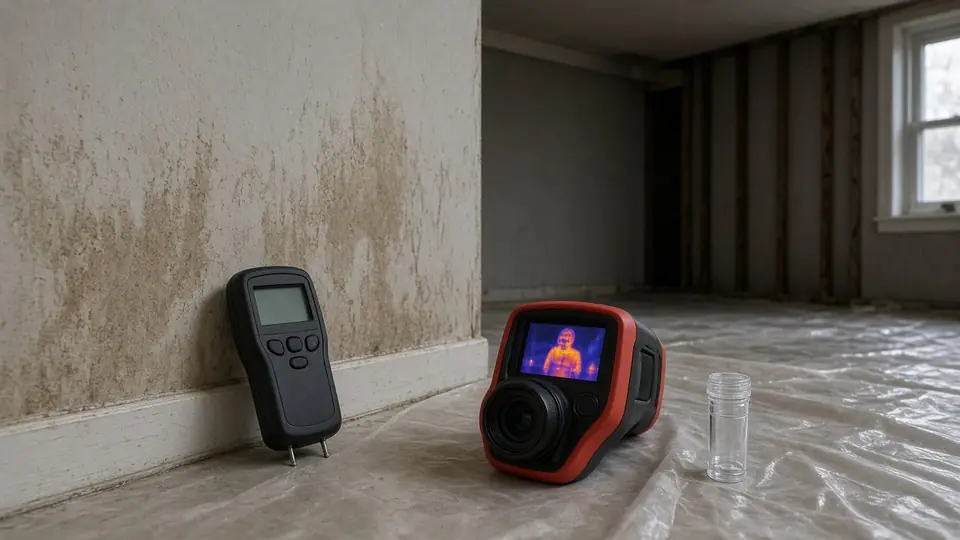
Book a White Plains mold assessment that names the source before any wall is cut
Mold or damp has turned up in your White Plains house or apartment, and the first quote already assumes a cause. Tell us what you saw, and get the assessment booked before anyone cuts.
Ask what keeps the water coming back. Asking commits you to nothing.
We help you find out what keeps sending water downstairs and get an assessment booked first, with any removal or drying from a different company after it.
In writing, before you book
Asking us costs nothing and binds you to nothing.
We ask what brings the water back before anyone cuts.
Whoever checks the result is not who removed the mold.
The $100 is applied the way our Terms page sets it out.
Each contractor answers for the work under their own contract.
Questions about a mold assessment, for White Plains
I am buying in White Plains. What should I ask the City?
Ask whether its list of properties damaged by floods holds anything for the address, and ask in writing. Then ask the seller for the water and mold answers on the state disclosure form before you sign a contract.
My unit is on a lower floor of a large building. Should I book the assessment?
You can, for your own space. If the wet part is shared, tell your board or owner in writing first, and ask what the building's rules say about access and who pays for shared parts.
The state studied the Bronx River here. Does that change my assessment?
No. The state's study looks at a river stretch that runs from Interstate 287 down to the Main Street bridge. An assessment reads your own walls and drains, and it asks where your water came from.
Signs
Marks that point to a mold assessment in White Plains
The stain sits on the outside wall of an upper unitThat can point to a roof, a window or an exterior wall rather than a basement. Tell the assessor which floor you are on and what is above you.
Damp in a lower-level room of a larger buildingShared drains and foundation walls may belong to the building. Tell the board or owner in writing, and share the assessor's readings once you have them.
A house basement stays damp after rainNote which rain it was and whether the sump or the downspouts ran. In a house, the water is often yours to trace.
A buyer or lender asks about water historyAsk the assessor for a written finding of the source and the affected areas that you can hand over, and ask the seller for the water and mold answers on the state form.
What the City's flood list can tell you
In its reply for the 2021 county plan, White Plains said its City list tracks properties damaged by floods. Ask what it holds for your address, and ask in writing, so you have a dated reply. Do the same if you are buying, and also ask the seller what they know.
A blank reply is not a clean bill. It says nothing about your own walls, so book the assessment either way.
Shared walls and shared drains: what to bring to the visit
The Census Bureau's survey of the city counts only about 28 percent of homes as detached houses. Many White Plains residents therefore live in something shared. That changes the first question. Instead of asking what is wrong with the wall, ask whose wall it is and who is allowed to open it.
House owners book directly. Unit owners book for their own space and tell the board or managing agent about anything shared. A building owner books for the whole stack or floor that is affected. A single written finding is easier to act on than five separate guesses, and it keeps neighbors from blaming each other.
Bring what you already know. Note the floor, the room, the side of the building and any plumbing work done nearby in the last year. An assessor who starts with that list spends the visit measuring instead of asking.
Before you rely on any City answer, ask Public Works what it covers
The Department of Public Works manages floodplain rules under Municipal Code Chapter 7-10. Ask it, in writing, what applies to your address before you plan repairs, and keep the dated reply with your papers.
Nothing the City publishes names a cause inside your wall, so let the assessor's readings decide what is wrong there.
If you plan to sell, the state's disclosure form asks whether the property was tested for indoor mold. Bring the assessor's written finding to that question, then pick another firm for any removal.